Category Archives: 5G

5G

5G is the fifth generation of wireless technology and represents a significant step forward in terms of speed, connectivity, and network capacity. It has the potential to enable a range of new use cases and services, including autonomous vehicles, smart cities, and remote healthcare. Here are some key things you should know about 5G:

  1. Speed: 5G promises significantly faster download and upload speeds than 4G, with some estimates suggesting that it could be up to 100 times faster. This increased speed will allow for real-time video streaming, fast downloads, and seamless connectivity.
  2. Latency: 5G has lower latency than 4G, which means that data can be transmitted with minimal delay. This is particularly important for applications that require immediate response times, such as remote surgery or self-driving cars.
  3. Capacity: 5G networks have the potential to handle a much larger number of connected devices than previous generations of wireless technology. This increased capacity will be important for supporting the growth of the Internet of Things (IoT) and other emerging technologies.
  4. Deployment: 5G is still in the early stages of deployment, and rollout will likely be gradual over the next few years. However, some regions have already begun to launch 5G networks, and many more are expected to follow suit.
  5. Use cases: 5G has the potential to enable a wide range of new use cases and services, from augmented reality and virtual reality to smart cities and autonomous vehicles. As 5G networks become more widespread, we can expect to see more innovative use cases emerge.

Overall, 5G represents a significant step forward in wireless technology, with the potential to revolutionize a wide range of industries and applications. As the technology continues to evolve and become more widely available, it will be important for businesses to stay up-to-date on the latest developments and opportunities.

5G Fixed Wireless for Business: AT&T vs. Verizon vs. T-Mobile

5G Fixed Wireless Business Internet Comparison: AT&T vs Verizon vs T-Mobile

Fast setup is the point. 5G fixed wireless (also called fixed wireless access) can connect a small office, retail location, remote site, or temporary setup without waiting on a wired install. The tradeoff is simple: reliability depends on the exact address and local network load.

Major US carriers Reliability comparison Retail businesses Fixed wireless vs fiber

Quick verdict (who should pick what)

Pick AT&T
You want simple plans + quick deploy, and you like the idea of a “priority data” option.
Pick Verizon
You want defined speed tiers (100/200/400) and you’re in a strong coverage area.
Pick T-Mobile
You want straightforward business internet pricing and wide reach, and you’re fine with “speeds vary” reality.

If fiber is available at the address, fiber usually wins for consistency. Fixed wireless is often best when you need speed of install, a backup circuit, or a temporary location.

Side-by-side: business 5G fixed wireless internet

Carrier Headline pricing Speed approach What helps reliability Best for Watch-outs
AT&T Internet Air for Business
Standard / Premium
$65 Standard
$105 Premium
AutoPay + Paperless discount mentioned
“Speeds vary by address”
Uses 4G LTE + 5G/5G+ where available
Premium includes 250GB priority treatment
Video Management feature on plans
Small offices, pop-ups, remote sites, backup internet Service is tied to the designated address. Congestion can slow speeds.
Verizon 5G Business Internet
100 / 200 / 400
$69 (100 Mbps)
Promo: save $30/mo when paired with select smartphone plan (limits apply)
Defined tiers: up to 100 / 200 / 400 Mbps Option for self-setup or pro install (varies by tier/location) Urban + higher demand locations; defined speed tiers Taxes/fees + Economic Adjustment Charge. Promo credits have rules.
T-Mobile 5G Business Internet
Nationwide 5G
Starting at $70
(Some flows show starting at $60)
“Speeds vary” fixed wireless delivered via 5G Designed for quick deployment + continuity use cases Businesses wanting a simple fixed wireless option Congestion may reduce speeds; notes mention further reduction after very heavy use.

Table is a snapshot. All three are address-based services. Always check the exact address before you decide.

AT&T Internet Air for Business
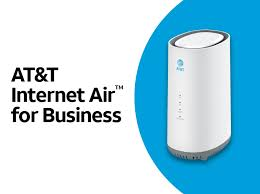
AT&T Internet Air for Business router and product graphic
  • Two plans: Standard ($65) and Premium ($105).
  • Video Management feature is included (can be toggled).
  • Premium: includes 250GB priority treatment per bill cycle; after that, speeds may slow when the network is busy.
  • Discount note: the product brief references a $5/mo discount when enrolled in AutoPay + Paperless Billing.
  • Address-based: you can only use it at the designated service address, and in-building signal quality matters.
Best use case: small offices, remote sites, pop-ups, and backup internet where fiber isn’t available or takes too long.
Check AT&T Internet Air availability Disclosure: I’m an AT&T Business Wireless Consultant. I can help you order AT&T services end-to-end.

Verizon 5G Business Internet (speed tiers + promos)

Verizon 5G Business Internet graphic
  • Speed tiers: up to 100 Mbps, 200 Mbps, or 400 Mbps (varies with congestion).
  • Pricing examples: the 100 Mbps plan is shown at $69/mo, plus taxes/fees and an Economic Adjustment Charge.
  • Promo angle: Verizon advertises saving $30/mo when paired with a qualifying business smartphone plan (rules and limits apply).
  • Switch offer: Verizon also advertises up to a $1,500 credit to help cover switching costs.
  • Guarantees: their page mentions a 10-year price guarantee for new customers in select areas, and a 30-day satisfaction guarantee (terms apply).
Best use case: locations that want defined speed tiers and are in strong 5G coverage (especially dense areas).

T-Mobile 5G Business Internet (simple fixed wireless option)

T-Mobile 5G Business Internet graphic
  • Pricing: T-Mobile markets Business Internet starting at $70 (some flows show starting at $60).
  • Data policy note: they state speeds may be lower during congestion and can be further reduced after very heavy monthly usage (they cite >1.2TB/mo).
  • Fees note: they mention a device connection charge due at sale, and that service is for use only at the activation location.
Best use case: businesses that want an easy fixed-wireless option with nationwide reach and predictable monthly pricing.

Reliability comparison (what actually determines “good” fixed wireless)

Most “carrier vs carrier” debates miss the point. The biggest factor is the specific address (signal strength + tower load + building materials + router placement).

  • Ask for an address check before you commit.
  • Test at the exact location during your busy hours (lunch rush, evenings, weekends).
  • Place the gateway right (window/upper area often beats back room / metal racks).
  • Have a backup plan if your POS or phone system can’t go down (secondary circuit or LTE/5G failover).

Retail businesses: POS + cameras + guest Wi-Fi

  • POS: prioritize consistency and latency over “peak speed.”
  • Cameras: watch upload performance; ask how the plan behaves when the network is busy.
  • Guest Wi-Fi: isolate it from POS traffic (separate SSID/VLAN if possible).
  • Temporary sites: fixed wireless is often ideal when you need internet fast.

Fixed wireless vs fiber (quick rule)

If fiber is available at the address, fiber usually wins for consistency, upload, and overall stability. Fixed wireless is the move when you need:

  • fast install,
  • a backup circuit,
  • a remote location,
  • or a temporary setup.

If you meant “business 5G mobile plans comparison”

This article is about internet for a location (fixed wireless). Mobile plans are about phones/tablets and priority levels per line. Different topic, different decision.

If you want, I can spin up a separate “AT&T vs Verizon vs T-Mobile business mobile plans” page so this fixed-wireless page stays focused.

FAQ

  • Which major US carriers offer 5G fixed wireless business internet?
    AT&T, Verizon, and T-Mobile all market fixed wireless business internet offerings, and all are address-based.
  • Which is more reliable for business fixed wireless: Verizon, AT&T, or T-Mobile?
    Reliability is mainly address + in-building signal + local network load. Test at the location and during business hours.
  • Is 5G fixed wireless good for retail businesses?
    It can be, especially for quick deployment. For POS/cameras, plan for consistency and a backup option if downtime is unacceptable.
  • Fixed wireless vs fiber for enterprise internet: which is better?
    If fiber is available, it usually wins. Fixed wireless is best for speed of install, backup, and hard-to-reach locations.

AT&T Business Plan calculator and promotions details

🌐 Exciting News for Business Owners! 📱

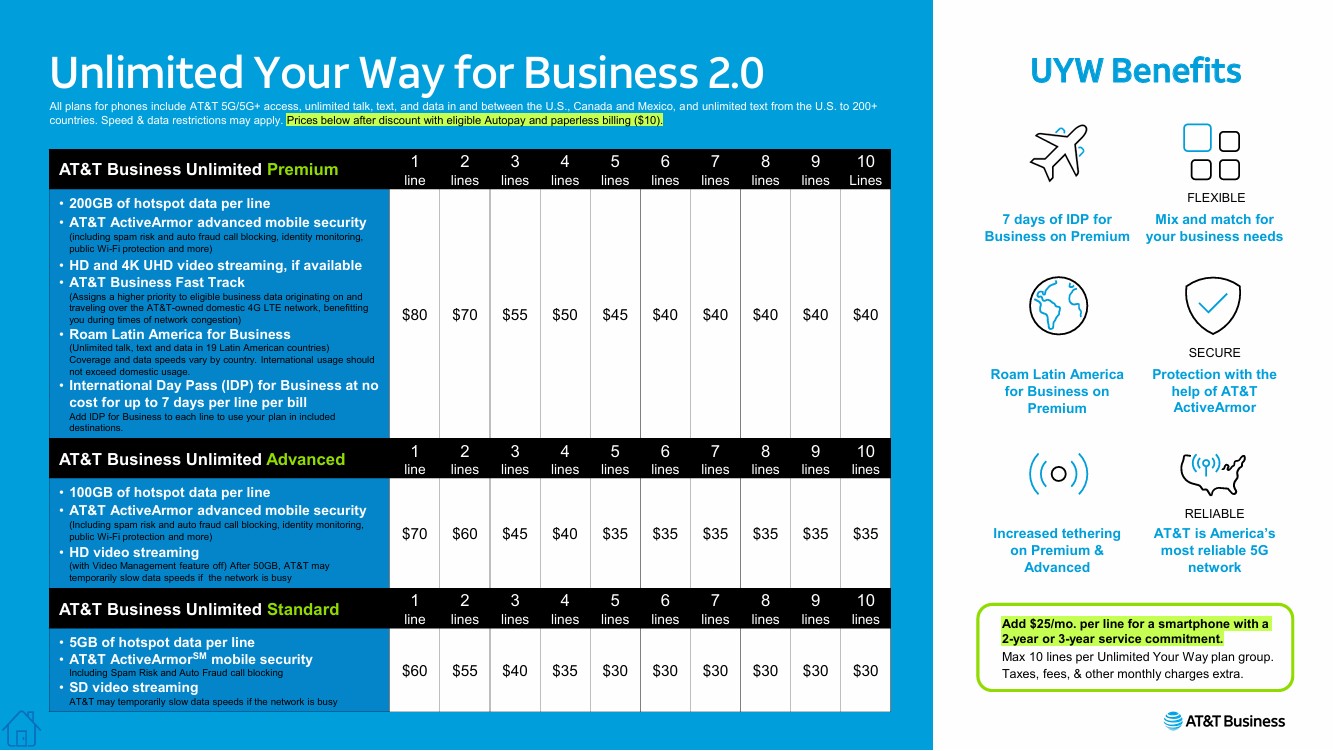
We’re thrilled to announce the availability of AT&T’s Unlimited Your Way for Business 2.0 plans on our website. Tailor your mobile plan to fit your business needs, whether you’re seeking premium features, advanced security, or just the essentials. Here’s what we offer:

infographic detailing AT&T's Unlimited Your Way for Business 2.0 plans with pricing for 1 to 10 lines. Includes Premium, Advanced, and Standard options with features like hotspot data, AT&T Active Armor advanced security, video streaming, and roaming benefits. Highlights benefits such as 7 days of International Day Pass for Business, flexible mix and match options, secure protection, increased tethering, and reliable 5G network coverage. Also notes an additional $25/month discount for smartphones with a 2- year service commitment. Perfect for businesses looking to optimize mobile plans with AT&T Business.

🔹 AT&T Business Unlimited Premium: Prices from $80 to $40 per line, featuring 200GB of hotspot data, advanced mobile security, HD & 4K streaming, priority data, and roaming benefits.

🔹 AT&T Business Unlimited Advanced: Prices from $70 to $35 per line, with 100GB hotspot data, robust security features, and HD streaming capabilities.

🔹 AT&T Business Unlimited Standard: Prices from $60 to $30 per line, providing 5GB hotspot data and standard security features.

💡 Pricing Clarity: Please note that all prices listed on our flyer and website already include the Autopay discount of $10 per line, when using a debit card or checking account. Our online Plan Calculator allows you to explore pricing options both with and without the Autopay discount, enabling you to make informed financial decisions tailored to your business needs.

💳 Flexible Payment Options: Customize how you acquire your devices. Choose from bringing your own device (BYOD), purchasing at full price, opting for monthly installments, or committing to a 2-year service plan to suit your budget and operational requirements.

📱 Device Pricing and Promotions: For a complete list of all AT&T devices available, their costs, current promotions, and a detailed explanation of how financing and promotional credits work, visit AT&T Business Device Pricing, AT&T Business Promotions, and 24-Month Smartphone Financing for Businesses.

🔗 Explore and Customize: Visit our site now to use the Plan Calculator and tailor your mobile plans. Discover the perfect mix of flexibility, security, and reliability on AT&T’s 5G network.

Calculate Your Savings and Customize Your Plan

Let’s make managing business communications simpler and more cost-effective!

Image of a business meeting with professionals smiling, holding smartphones with the AT&T logo, and shaking hands in a boardroom, symbolizing their partnership with AT&T. This represents the welcoming of business clients to AT&T’s services, including Unlimited Your Way for Business 2.0 plans, highlighting a successful professional environment.

How to Solve ESIM Deployment Issues for Large Businesses

The ESIM Problem Businesses Face During MDM Rollouts

Managing large-scale mobile accounts comes with unique challenges. Recently, I had the opportunity to support the IT team of a major extermination company, which oversees more than 2,000 wireless lines. They were in the middle of rolling out a new Mobile Device Management (MDM) system when they hit an unexpected snag: end users were accidentally deleting their ESIMs.

This might sound like a small issue, but in a large-scale deployment like theirs, even minor setbacks can snowball into major disruptions. The good news? I had a straightforward, efficient solution.

How I Solved an ESIM Deployment Crisis for a Large Business

The IT team simply provided me with the IMEI numbers for the affected devices. From there, I was able to instantly push new ESIMs to each device. This quick response not only saved valuable time but also helped them avoid the frustrating and time-consuming process of contacting AT&T support during such a critical rollout period.

Why Hands-On Support Matters for Wireless Transitions

For businesses managing thousands of wireless lines, these kinds of specialized, hands-on solutions make all the difference. This experience is just one example of how I help AT&T business clients streamline their telecommunications operations—whether it’s solving deployment challenges, optimizing mobile solutions, or keeping their teams connected without disruption.

Contact Me for Streamlined Business Wireless Solutions

If your business is facing wireless headaches or complex IT transitions, reach out to learn more about how I can help. Let’s make your wireless strategy as seamless and efficient as possible.